
You can almost hear the countdown before you've booked anything. Champagne flutes clink, the ship's decks glow against black water, and somewhere in the distance a band is warming up for midnight. A New Year's Eve cruise promises all the celebration with none of the cleanup, but it also asks more of you than a random winter getaway.
Most travelers don't get stressed by the party itself. They get stressed by the parts no one talks about enough. Which sailing should you choose? How early is early enough to book? What counts as formal on gala night? Will fireworks happen? If you're traveling with kids, grandparents, or friends with very different energy levels, those questions matter even more.
The good news is that this trip gets much easier when you treat it as a planning project first and a party second. That shift is what turns holiday chaos into a smooth, festive week at sea.
Table of Contents
- Why a New Year's Eve Cruise Is Your Best Bet for 2026
- Choosing Between Ocean and River Itineraries
- Mastering the Booking Timeline and Budget
- Navigating Onboard Etiquette and Logistics
- Coordinating Multi-Generational Groups
- Next Steps for Your Stress-Free Celebration
Why a New Year's Eve Cruise Is Your Best Bet for 2026
By 11:30 p.m., the hard part should already be over. You should know where you're standing for the countdown, when dinner ends, whether your group wants the pool deck or the lounge, and how long it will take to get back to the cabin once the party breaks up. That is appeal of a New Year's Eve cruise. It puts the celebration, your room, your meal, and your transportation in one controlled environment.

The atmosphere matters, of course. Midnight at sea feels festive in a way land-based plans often do not. But the stronger reason to choose this trip for 2026 is structural. Holiday sailings reduce the number of moving parts you have to manage during one of the busiest travel weeks of the year.
That benefit only holds if you book and choose carefully.
Holiday demand changes the math
New Year's Eve cruises sit in a compressed, high-pressure booking window. Cabins are limited, flights are expensive, and the wrong room choice is harder to fix once ships fill. Cruise Critic's New Year's Eve cruise guide notes that these departures often sell quickly, with holiday sailings commonly booked many months ahead and premium categories disappearing first.
In practice, that means a holiday cruise rewards planners and punishes procrastinators. A ship may still show space for late bookers, but not in the cabin type, deck location, or dining setup that makes the week feel easy. On a standard off-season sailing, you can sometimes absorb a compromise. On New Year's week, small compromises tend to show up every day.
A balcony near the elevators may sound acceptable at booking. It feels different after midnight when half the ship is heading back to bed.
2026 is a good year to treat this as a logistics decision
Cruise demand remains strong, and holiday departures feel that pressure first. You do not need a complicated market forecast to see the effect. Popular sailings tighten early, airfare rarely improves close to departure, and family schedules leave less room to shift dates once school breaks and work calendars are set.
That is why I usually advise clients to judge a New Year's cruise less like a party ticket and more like a bundled holiday operation. You are not only buying a countdown event. You are buying control over where you sleep, how you eat, how you move through the evening, and how much uncertainty you are willing to accept during peak season.
That trade-off is worth real money for the right traveler.
The ship solves problems that land-based New Year's plans create
On land, New Year's Eve often comes with extra reservations, surge pricing, transportation issues, and a long list of small decisions nobody wants to make at 10 p.m. A cruise strips out many of those friction points. Your dinner is nearby. Entertainment is built in. You do not need to appoint a driver, chase multiple bookings, or end the night in a rideshare queue.
There are limits. Holiday sailings also bring crowds, fixed schedules, and premium pricing. You may pay more than you would for a non-holiday week, and you need to be comfortable sharing the experience with a lot of other people who chose the same idea for the same reason. For many travelers, that is still a better bargain than building a complicated New Year's trip piece by piece.
What to expect, and what not to assume
A well-run New Year's sailing usually includes special dining, dressier evening energy, and a coordinated countdown. It does not guarantee every detail travelers imagine. Fireworks can depend on port rules, weather can change deck plans, and the most popular venues can fill early.
Book the sailing for the full trip, not for one photo at midnight.
That mindset leads to better decisions. You start asking practical questions: Is the itinerary long enough to feel worth the holiday fare? Will the public spaces feel manageable for your group? Are you paying for a party atmosphere you want, or for a calmer week where the holiday happens to fall onboard? Those are the questions that make a New Year's Eve cruise a smart choice for 2026, rather than an expensive guess.
Choosing Between Ocean and River Itineraries
By the time New Year's Eve arrives, the wrong ship choice shows up in very practical ways. You feel it in the dinner wait, the line for the elevator, the walk back to your cabin after midnight, and the question your group keeps asking all week: did we book the celebration we wanted?
Ocean and river cruises solve different holiday problems. Ocean ships give you more backup plans if tastes vary or weather disrupts deck events. River ships reduce decision fatigue and usually keep the evening more contained. For New Year's travel, that difference matters as much as the destination.
Ocean ships work better for variety and crowd dispersion
A large ocean ship is usually the safer choice if your group will split up and reconvene throughout the night. Multiple lounges, restaurants, and entertainment spaces spread people out, which helps on one of the busiest sailings of the year. Mainstream lines such as Royal Caribbean and Carnival tend to build the evening around organized parties and high attendance in public areas. Premium lines such as Holland America and Princess often keep the schedule festive but a little more measured.
That scale comes with trade-offs. Bigger ships ask more from you logistically. You need to reserve dining at the right time, arrive early for popular venues, and accept that elevators and central atriums will be busiest right before midnight and right after.
River cruises work better for travelers who want fewer moving parts
River cruises usually attract travelers who care less about a packed party schedule and more about a calm, well-paced holiday week. The ship is smaller, the social rhythm is easier to read, and you are not spending the evening choosing between six venues on different decks. For some travelers, that is a relief.
The limit is just as clear. Smaller ships give you fewer ways to escape a crowded lounge or a social atmosphere that does not fit your mood. If you like options, a river cruise can feel restrictive by New Year's Eve. If you want a quieter holiday with less internal logistics, it often feels far easier to manage.
If you're still getting familiar with the format, this guide on what a river cruise is gives useful context before you compare specific lines.
A large ship gives you more places to go when the crowd shifts. A river ship gives you a simpler evening with fewer decisions to make.
Match the line style to your tolerance for crowds, structure, and noise
Travelers often compare cruise types by atmosphere alone. I'd compare them by friction points.
- Mainstream ocean lines such as Royal Caribbean, Carnival, and Norwegian fit travelers who want lots of venue choice and do not mind heavier foot traffic around headline events.
- Premium ocean lines such as Holland America, Princess, and Celebrity usually suit travelers who want holiday programming without the same all-night party intensity.
- River operators such as AmaWaterways and Viking generally appeal to travelers who prefer destination time, smaller public spaces, and a more predictable onboard flow.
- Luxury ocean lines such as Regent, Silversea, Seabourn, and Crystal offer more space per guest and stronger service ratios, but they also come at a very different price point during holiday weeks.
Selecting the Right Cabin for Your Celebration
| Cabin Type | Best For | Considerations |
|---|---|---|
| Inside | Travelers who plan to spend most of the evening in public spaces | Usually the value choice, but you lose natural light and a private place to step outside |
| Oceanview | Travelers who want daylight in the room without paying for outdoor space | A practical middle option, though it will not help much if you want a quiet retreat during busy evening hours |
| Balcony | Couples, light sleepers, and anyone who wants a private break from the crowd | Often worth the premium on holiday sailings, but these cabins tighten up early |
| Suite | Multi-generational travelers, milestone trips, and guests who need more room | Extra space helps with comfort and coordination, though holiday pricing can rise quickly |
Cabin choice affects your New Year's Eve more than many travelers expect. If you plan to stay out until late and only sleep there, an inside cabin may be perfectly sensible. If you know you will want a private reset before dinner or after the countdown, paying for a balcony or suite is often money well spent.
Mastering the Booking Timeline and Budget
You find the right New Year's Eve sailing, see a fare that looks manageable, and assume the hard part is over. In practice, holiday cruise planning usually breaks down later, when cabin inventory shrinks, air prices jump, and small line-item costs start stacking up around a fixed calendar date.
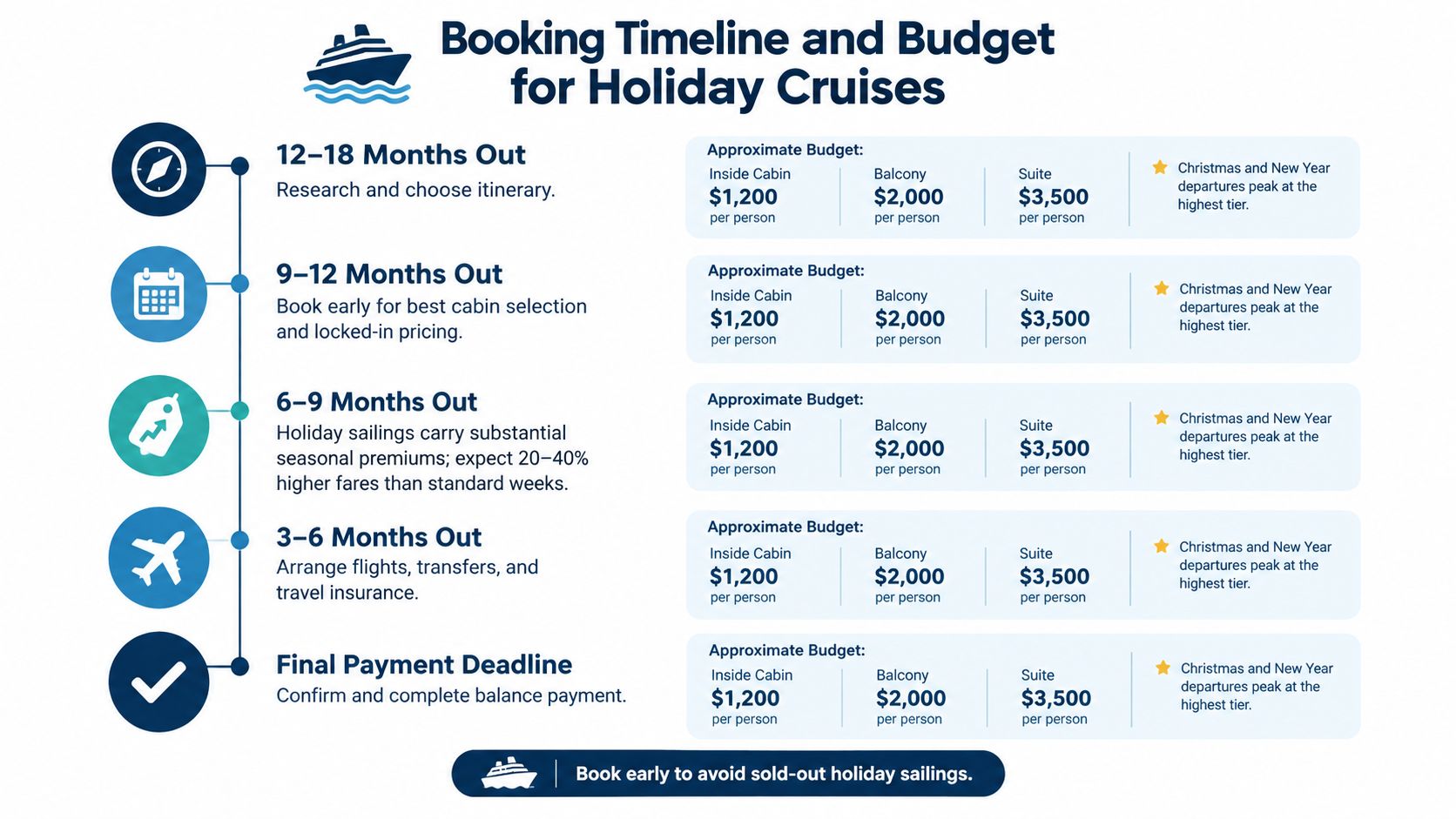
Build your timeline backward from the holiday
New Year's Eve sailings are less forgiving than a random spring departure. You are working around one of the busiest travel weeks of the year, and the best choices disappear long before the ship sells out completely.
Start with the date and work backward through the pieces that are hardest to replace later: cabin category, flights, pre-cruise hotel, transfers, and dining times. If you want a clearer planning window, this guide on the best time to book a cruise gives useful context for how holiday bookings differ from quieter weeks.
My rule is simple. Book the parts that protect the trip first, then fill in the extras.
A practical sequence looks like this:
- Choose the sailing based on logistics, not just mood. Port city, flight access, embarkation timing, and sea-day count matter as much as the countdown itself.
- Reserve the cabin type you want. Holiday inventory rarely disappears all at once. What disappears first are the cabins that make the trip easier, such as midship balconies, connecting rooms, and well-priced suites.
- Lock in air and arrival timing early. A pre-cruise hotel night often costs less than the stress of trying to fly in on embarkation morning during holiday week.
- Handle reservations and transfers while options are still orderly. Waiting usually means fewer time slots, less choice, and more compromises.
Budget for the trip around the fare
The cruise fare is only the starting number. Holiday sailings often carry higher base pricing, but the bigger budgeting mistake is ignoring the extras that become harder to avoid in a celebratory week.
One industry article on hidden cruise fees to watch for notes that some Christmas and New Year bookings may include gala-dinner surcharges. Policies vary by line and itinerary, which is exactly why you should ask for the full cost structure before you pay a deposit.
Ask these questions directly:
- Are holiday dinners and events included in the fare, or priced separately?
- Do specialty restaurants charge supplements on New Year's Eve?
- Are beverage packages, Wi-Fi, and gratuities part of the booking, or added later?
- What will airport transfers, hotels, and port transportation add to the total?
Group bookings need even closer review. On one operator's Boston Harbor New Year's Eve cruise details, drinks are excluded, onboard payment is card-only, and larger parties face added gratuity rules. Ocean and river lines handle these details differently, but the lesson is the same. Holiday events often come with tighter terms than a standard departure.
This short video gives a useful visual overview of cruise planning timing and tradeoffs.
Terminal timing matters more than travelers expect
Embarkation day exposes weak planning fast. Travelers who arrive too late risk a stressful start. Travelers who arrive far too early usually end up standing in a larger crowd without gaining any real advantage.
Your assigned check-in window matters more than the ship's departure time.
Follow the line's arrival instructions, give yourself buffer for traffic and security, and avoid same-day flight plans that leave no room for delays. The same logic applies at the end of the cruise. Disembarkation can start early, and holiday port areas tend to get crowded once luggage pickup, customs flow, and ground transfers all converge.
For travelers who want help comparing cruise lines, cabin categories, and the holiday details that do not show clearly online, Passport to Adventure, LLC can coordinate cruise selection, flights, transfers, and pre-sailing logistics as one planning flow.
Navigating Onboard Etiquette and Logistics
A New Year's Eve cruise has its own social rhythm. The ship may feel festive all week, but gala night brings clearer expectations around clothing, timing, and what counts as included.

Dress for the room you're walking into
A lot of travelers get tripped up by the phrase smart casual. A cruise attire guide explains that smart casual includes skirts, dresses, slacks, blouses, pants, and collared shirts, while pool or beach attire, shorts, and distressed jeans aren't allowed in dining rooms, and shoes are required, according to this cruise dress code guide.
That matters even more on holiday sailings because the New Year's Eve dinner can feel more special than a regular sea day meal.
A simple packing approach works well:
- One polished dinner outfit that fits the line's evening standard
- Comfortable shoes for standing at parties or moving between venues
- A light layer for open-deck viewing areas, even in warm-weather itineraries
- Medication and essentials in your carry-on, not buried in checked luggage
Fireworks aren't guaranteed
Many travelers build the whole night around fireworks. That's understandable, but it's not a safe assumption. One Thames New Year's Eve cruise operator states that the fireworks display is outside its control and there's no obligation to issue refunds if the display is altered or canceled, according to City Cruises London's New Year's Eve terms.
That same logic applies more broadly. Port authority decisions, weather, visibility, and local event controls can all reshape the evening.
Treat fireworks as a bonus, not the contract.
Don't ignore documentation and destination timing
Holiday itineraries can create very ordinary travel problems at very inconvenient moments. If your sailing includes international ports, confirm passport validity, entry requirements, and any medical considerations with official government sources and your advisor well before departure. Requirements can change, and year-end travel leaves less room to fix mistakes quickly.
On the destination side, closures matter too. Independent port guidance for Cam Ranh, Vietnam notes that Tet can shut down most shops, markets, and many restaurants for three core days and sharply reduce transportation availability, according to CLIA-linked context and port disruption planning in the 2024 State of the Cruise Industry Report materials. Even if you aren't sailing in Asia, the lesson is universal. Holiday periods can affect what's open, how quickly you can move, and whether shore plans stay flexible.
Coordinating Multi-Generational Groups
New Year's Eve can expose every difference in a family travel style. One person wants the midnight countdown, one wants a quiet dinner, one needs an afternoon nap, and one child is already melting down by dessert. The trick isn't forcing everyone into the same plan. It's giving the group a shared framework with room to peel off.
Start with shared anchors, not a packed schedule
CLIA reports a projected 37.3 million ocean-going cruise passengers in 2025, with about 35% under 40 and 34% over 60, while roughly one-third of cruise trips involve multiple generations traveling together, according to the CLIA global overview. That mix explains why New Year's Eve sailings need more than party planning. They need rhythm.
Choose a few key moments the whole group will share, such as sailaway, one family dinner, and the countdown plan. Let the rest of the day breathe.
Cabin setup solves more problems than people expect
Connecting cabins, nearby staterooms, and suite configurations can reduce friction before it starts. Grandparents may want early quiet. Parents may want easier bedtime logistics. Adult siblings may want to stay out later without waking the whole room.
A few ground rules help:
- Set a meeting point. Pick one lounge, stairwell bank, or café as the regrouping zone.
- Separate celebration from sleep when possible. A little extra cabin space can protect everyone's mood.
- Plan recovery time on New Year's Day. Don't overschedule the morning after a late night.
- Define supervision clearly. “We all thought someone else had the kids” is not a holiday memory you want.
If you're the person coordinating cabins and personalities, this guide on how to plan a group trip can help you organize the moving parts before final payment.
The most successful family holiday sailings aren't the ones where everyone does everything together. They're the ones where everyone feels considered.
Next Steps for Your Stress-Free Celebration
A smooth New Year's Eve cruise comes down to a few decisions made early and made clearly. Pick the right cruise style first. Budget for holiday-specific extras instead of assuming the fare tells the whole story. Respect the check-in process, the dress code, and the fact that some marquee moments depend on weather or local authority approval.
The payoff is worth it. You get a celebration with built-in dining, music, scenery, and a cabin waiting just down the corridor. No fighting traffic after midnight, no hosting duties the next morning, and no scramble to coordinate ten different reservations across town.
If you're traveling with family or friends, communicate expectations early. Decide who wants late-night energy, who needs downtime, and which shared moments matter most. The more honest you are before booking, the more relaxed the sailing feels once you're onboard.
Good planning doesn't make this trip less festive. It makes it possible to enjoy the festive parts without spending the whole month before departure juggling loose ends.
If you want help sorting through ocean versus river options, comparing cabin categories, or building the right holiday plan for your group, Passport to Adventure, LLC handles the details that usually create stress on high-demand sailings. You can get personalized support with cruise selection, flights, transfers, and the small planning choices that make your New Year's Eve trip feel easy from the start.
Meta description: Plan a stress-free New Year's Eve cruise with practical advice on booking timelines, cabin choices, holiday fees, dress codes, and group travel logistics.